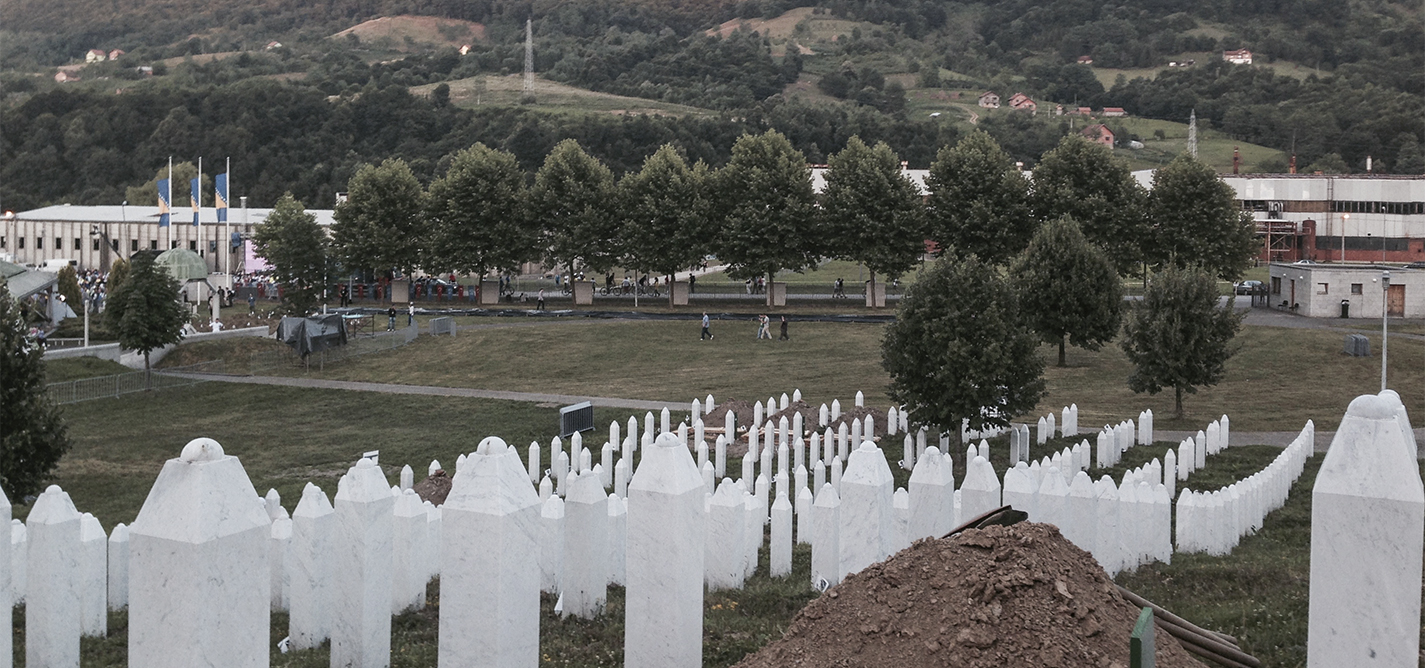
Twenty-five years after the Srebrenica Genocide
Accounting for the missing in Bosnia and Herzegovina and beyond.
At the end of his mission, Mazowiecki concluded that “human rights simply do not exist in Bosnia and Herzegovina.”
By the signing of the Dayton Peace Agreement in 1995 that ended the war, around 100,000 people had perished, a figure that included over 27,000 missing persons.
Today, families honor the memory of their missed (and formerly missing) loved ones.
Victims who will be buried in Potočari on July 11, 2020
Sead (Huso) Hasanović
1971-1995
Alija (Bekto) Suljić
1969-1995
Hasan (Alija) Pezić
1925-1995
Hasib (Šaban) Hasanović
1970-1995
Zuhdija (Suljo) Avdagić
1947-1995
Bajro (Ramo) Salihović
1943-1995
Ibrahim (Hamid) Zukanović
1941-1995
Salko (Ahmo) Ibišević
1972-1995
Kemal (Husein) Musić
1968-1995

Lara J. Nettelfield
Lara J. Nettelfield is a Senior Lecturer in the Discipline of Human Rights at the Institute for the Study of Human Rights at Columbia University. She is co-author of “Srebrenica in the Aftermath of Genocide” (Cambridge University Press, 2015) and author of “Courting Democracy in Bosnia and Herzegovina: The Hague Tribunal’s Impact in a Postwar State” (Cambridge University Press, 2012), winner of the Marshall Shulman Book Award. She tweets @LJNettelfield
DISCLAIMERThe views of the writer do not necessarily reflect the views of Kosovo 2.0.
This story was originally written in English.